Slang moves faster than trends, and if you blink, you miss a whole new language forming online. One day it’s emojis, the next it’s short phrases that carry full-on attitude.
That’s exactly what’s happening with bffr meaning in text—a phrase you’re probably seeing everywhere right now.
From TikTok comments to Instagram replies and even gaming chats, “BFFR” is showing up in conversations where people want to call something out instantly. It’s short, punchy, and loaded with emotion.
If you’ve ever seen it and thought, wait… what does that actually mean?, you’re not alone. Let’s break it down properly so you can understand it—and use it like a pro.
What does bffr meaning in text mean in slang?
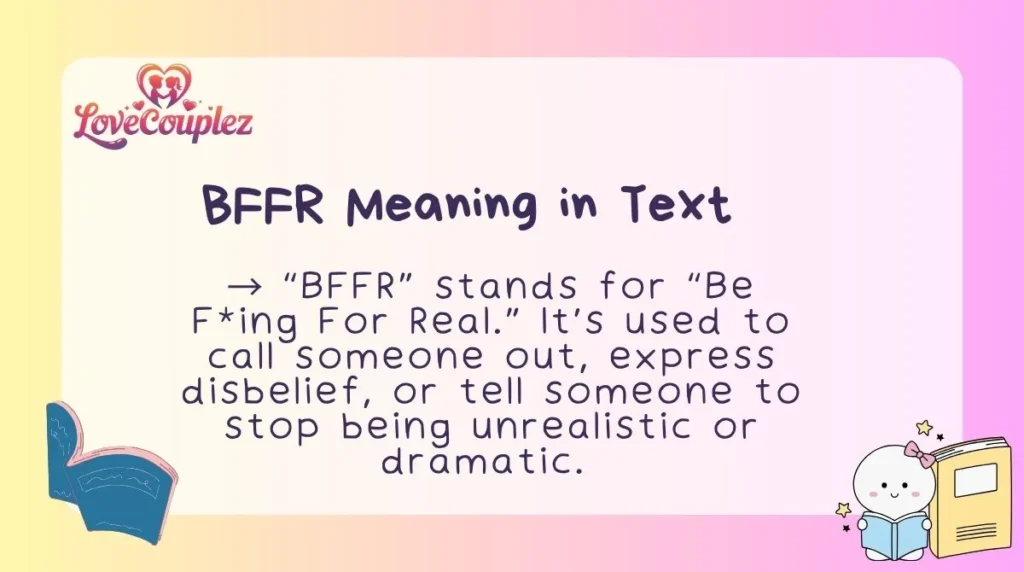
→ “BFFR” stands for “Be F*ing For Real.” It’s used to call someone out, express disbelief, or tell someone to stop being unrealistic or dramatic. It’s often sarcastic, blunt, and slightly confrontational depending on tone.
Quick Meaning Points:
• Tone: Mostly Negative / Sarcastic / Playful
• Who uses it most: Gen Z and young social media users
• Where used most: TikTok, Instagram, texting, gaming chats
• Example sentence: “You think he’s gonna text you back after that? BFFR 😭”
Core Meaning Explained
At its core, bffr meaning in text is about reality checks. It’s what people say when something sounds ridiculous, exaggerated, or just not believable.
The phrase “Be F*ing For Real” carries strong emotional energy. It’s not just disagreement—it’s disbelief mixed with attitude. When someone uses “BFFR,” they’re basically saying:
- “You can’t be serious.”
- “That makes no sense.”
- “Stop playing.”
- “Come back to reality.”
What makes it powerful is its flexibility. It can be:
- Playful between friends joking around
- Sarcastic in comment sections
- Harsh if used in arguments
Tone depends heavily on context and relationship. The same word can feel funny or offensive.
Origin + Evolution Timeline
Early internet roots
“Be for real” has been around in casual speech long before the internet. People used it in conversations to question something unrealistic.
Meme spread phase
As social media grew, especially short-form video platforms, phrases started getting shortened. “Be for real” turned into “BFFR” to match fast typing and meme culture.
Mainstream adoption
TikTok played a huge role. Creators began using “BFFR” in captions and reaction videos. It quickly became part of viral humor and comment culture.
2026 current usage
Now in 2026, “BFFR” is fully embedded in digital communication. It’s used daily across multiple platforms and understood instantly by Gen Z audiences. It’s no longer niche—it’s mainstream slang.
How Gen Z Uses BFFR Meaning in Text Today
TikTok
This is where it thrives the most. People use it in comments reacting to videos that feel unrealistic, dramatic, or exaggerated.
Example:
“Girl said she wakes up at 5am every day to work out… BFFR 💀”
Discord
In gaming or group chats, it’s used casually to call out wild claims.
Example:
“You said you didn’t rage quit? BFFR bro.”
Gaming chat
Players use it during competitive matches when someone says something unbelievable.
Example:
“You weren’t trying? BFFR.”
Instagram comments
Used heavily under reels and posts, especially in sarcastic or humorous contexts.
Example:
“He said he’s loyal but liked every pic… BFFR 😭”
Text messages
In private chats, it’s more playful but still direct.
Example:
“You think I’m waking up at 6am tomorrow? BFFR.”
Real Chat Style Examples
Friend 1:
“I think he still likes me even though he blocked me.”
Friend 2:
“BFFR… you deserve better.”
Friend 1:
“I’m gonna finish this assignment in 10 minutes.”
Friend 2:
“BFFR 😂”
Friend 1:
“I didn’t eat your snacks.”
Friend 2:
“BFFR I saw the wrapper 😭”
Friend 1:
“I’m not addicted to my phone.”
Friend 2:
“BFFR you’ve been online all day.”
Similar Slang Comparison Section
Understanding similar slang helps you use “BFFR” correctly.
“Be serious”
Much softer version. No attitude, more polite.
“Cap”
Means someone is lying. “BFFR” is more about disbelief than lying.
“Delulu”
Short for delusional. Often overlaps with BFFR but is more playful and less direct.
“No way”
Expresses disbelief but without sarcasm or aggression.
“Stop playing”
Very close meaning, but more casual and less intense.
Key difference:
“BFFR” feels sharper, more sarcastic, and more expressive than all of these.
Psychological + Social Meaning
Slang like “BFFR” isn’t random—it reflects how people interact online.
Why people use this slang
People want fast communication. Instead of long explanations, “BFFR” delivers emotion instantly.
Social validation behavior
Using trending slang makes people feel part of a group. When you say “BFFR,” others instantly recognize your tone and mindset.
Online identity signaling
It shows you’re updated with internet culture. It signals humor, awareness, and sometimes confidence or boldness.
In short, it’s not just a word—it’s social positioning.
When NOT To Use This Slang
Even though it’s popular, there are situations where it doesn’t fit.
Professional situations
Never use it in emails, work chats, or formal communication.
Older audience
Some people may not understand it or may find it rude.
Formal writing
Avoid using it in essays, reports, or academic content.
Serious conversations
It can come off as dismissive or disrespectful.
Is This Slang Still Trending in 2026?
Yes—and strongly.
“BFFR” is still widely used across platforms in 2026. It has staying power because:
- It’s short and easy to type
- It expresses strong emotion quickly
- It fits meme culture perfectly
Future prediction
It may evolve into new variations or get replaced eventually, but right now it’s still highly relevant. Expect it to stay active for at least another year or more in online conversations.
Pro Tips to Use Naturally
• Use it in casual chats only
• Match the tone with emojis (😂 😭 💀)
• Don’t overuse it—it loses impact
• Use it with friends who understand slang
• Keep context playful unless you mean to sound serious
Common Mistakes Section
Using it in formal settings
This makes communication look unprofessional.
Overusing it
If you say it in every sentence, it loses meaning.
Using it aggressively
It can sound rude if tone isn’t clear.
Misunderstanding context
Not every situation needs a reality check.
Using it with the wrong audience
Some people may not understand or may feel offended.
Related Slang Words (Mini Glossary)
Delulu
Believing unrealistic things in a funny way
Cap / No cap
Cap = lie, No cap = truth
Sus
Suspicious or questionable
Bet
Agreement or confirmation
Slay
Doing something confidently or successfully
Mid
Average or not impressive
Lowkey
Secretly or slightly
Highkey
Openly or strongly
FAQ
What does BFFR mean in text messages?
It means “Be F*ing For Real,” used to express disbelief or call someone out casually.
Is BFFR rude?
It can be, depending on tone. With friends it’s playful, but in serious situations it may sound harsh.
What is BFFR meaning on TikTok?
On TikTok, it’s commonly used in comments to react to unrealistic or dramatic content.
Who started using BFFR?
It grew organically from internet culture and became popular through social media, especially TikTok users.
Can I use BFFR in daily conversation?
Yes, but mostly in informal chats. Avoid using it in professional or formal settings.
Conclusion
“BFFR” is more than just a slang term—it’s a quick emotional reaction packed into four letters. It reflects how modern communication is evolving: faster, sharper, and more expressive.
If you understand when and how to use it, you instantly sound more natural in today’s digital conversations. Just remember—context is everything.