Slang doesn’t wait for permission. It evolves fast, spreads faster, and suddenly you’re seeing a random three-letter phrase everywhere—from TikTok captions to gaming chats—and wondering what just happened. That’s exactly the case with fjb meaning in text.
If you’ve spotted “FJB” in comments, memes, or even casual messages, you’re not alone. It’s one of those modern slang terms that blends internet culture, politics, and humor into something short, punchy, and highly context-driven.
In 2026, slang isn’t just about words—it’s about identity, expression, and sometimes subtle messaging. And FJB sits right in the middle of that shift.
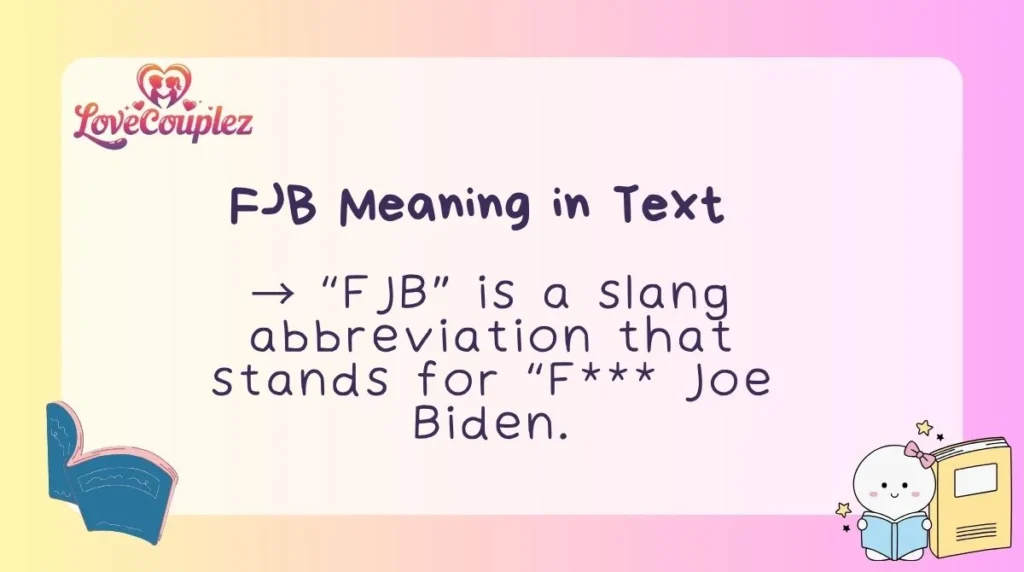
What does fjb meaning in text mean in slang?
→ “FJB” is a slang abbreviation that stands for “F*** Joe Biden.” It is typically used online to express political criticism or frustration, often in a sarcastic, meme-based, or coded way to avoid direct language filters.
Quick Meaning Points:
• Tone: Negative / Critical
• Who uses it most: Social media users, meme creators, politically active Gen Z and Millennials
• Where used most: TikTok, Twitter/X, comment sections, gaming chats
• Example sentence: “Did you see that policy update? FJB fr.”
Core Meaning Explained
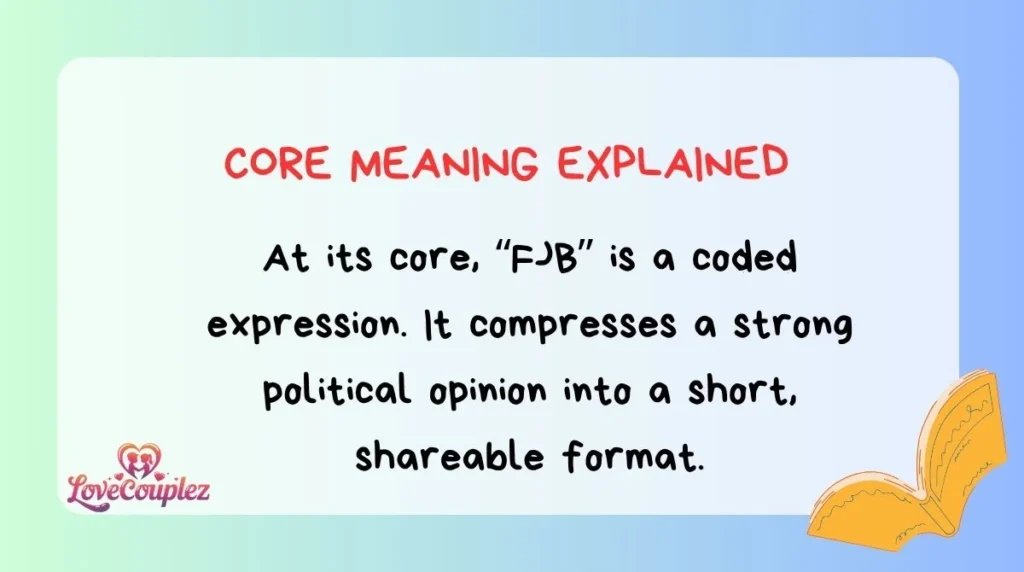
At its core, “FJB” is a coded expression. It compresses a strong political opinion into a short, shareable format.
But here’s where it gets interesting—modern slang isn’t always literal. While “FJB” originally had a direct meaning, its usage has expanded in tone and context:
- Sometimes serious (political frustration)
- Sometimes ironic (used jokingly or sarcastically)
- Sometimes meme-based (used just for engagement or humor)
In digital communication, people don’t always use slang because they fully believe it. They use it because it fits the vibe of the conversation.
So, the meaning in text depends heavily on:
- Who is saying it
- Where it’s posted
- The tone of the conversation
That’s why understanding slang today is less about definitions and more about context.
Origin + Evolution Timeline
Early internet roots
“FJB” gained traction in the early 2020s as a shorthand tied to political slogans. It became popular as a workaround for censorship and content moderation filters.
Meme spread phase
Soon after, meme pages picked it up. It appeared in reaction images, sarcastic captions, and viral posts. This phase stripped some of its seriousness and added humor.
Mainstream adoption
As more users saw it repeatedly, it moved beyond political spaces into general online culture. Even users not deeply involved in politics started using it casually.
2026 current usage
Today, “FJB” is part of meme language. It’s still political, but also symbolic of how internet users:
- Compress opinions into acronyms
- Use coded language to bypass filters
- Blend humor with criticism
How Gen Z Uses FJB Today (2026 Focus)
Gen Z doesn’t just use slang—they remix it. Here’s how “FJB” shows up across platforms:
TikTok
- Used in captions with memes or satire
- Sometimes hidden in hashtags
- Often paired with trending sounds for irony
Discord
- Casual chat reactions
- Used during debates or heated conversations
- Sometimes dropped as a joke mid-convo
Gaming chat
- Quick emotional reactions
- Used similarly to “bruh” or “nah” but with political tone
Instagram comments
- Seen under news posts or viral clips
- Often used to trigger engagement or reactions
Text messages
- Rare in serious chats
- More common in joking or meme-sharing conversations
Real Chat Style Examples
Friend 1: Bro did you see that news update?
Friend 2: Yeah… FJB honestly
Friend 1: This game lagging again 😭
Friend 2: FJB energy fr
Friend 1: Why is everything getting expensive
Friend 2: FJB moment 💀
Friend 1: You serious or joking?
Friend 2: Half joking… half not 😅
Similar Slang Comparison Section
Understanding “FJB” becomes easier when you compare it with similar slang:
L + ratio
- Used to mock someone online
- Less political, more social dominance
SMH (shaking my head)
- Expresses disappointment
- Softer tone than FJB
W / L
- Simple win/loss slang
- Neutral compared to FJB’s strong tone
NPC
- Used to criticize someone’s behavior as robotic
- Indirect insult vs direct criticism
COPE
- Tells someone they’re struggling to accept reality
- More psychological, less political
FJB stands out because it mixes:
- Emotion
- Opinion
- Cultural context
Psychological + Social Meaning
Slang like “FJB” isn’t just language—it’s behavior.
Why people use this slang
- To express strong opinions quickly
- To fit into a group or trend
- To avoid long explanations
Social validation behavior
Posting or commenting “FJB” can:
- Attract likes from like-minded users
- Spark debate (which boosts engagement)
- Signal alignment with a certain viewpoint
Online identity signaling
In 2026, what you say online = who you are perceived to be.
Using slang like this can signal:
- Political stance
- Humor style
- Level of internet awareness
When NOT To Use This Slang
Even though it’s popular, it’s not always appropriate.
Professional situations
Avoid in:
- Work emails
- LinkedIn posts
- Job interviews
Older audience
Some people may:
- Misunderstand it
- Find it offensive
Formal writing
Never use in:
- Academic essays
- Business documents
Slang is about context—and using it in the wrong place can backfire.
Is This Slang Still Trending in 2026?
Yes—but with a twist.
“FJB” is no longer just a trend. It’s part of internet culture history.
However:
- Its peak virality has passed
- It still appears in niche communities
- It’s often used ironically now
Future prediction
Slang like this won’t disappear—it will evolve.
Expect:
- New variations
- More coded expressions
- Less direct political wording
Because the internet always moves toward:
Shorter + smarter + more subtle communication
Pro Tips to Use Naturally
• Only use it if it fits the conversation tone
• Understand the context before dropping it
• Don’t overuse—it loses impact
• Use humor to soften the meaning
• Avoid in mixed or unknown audiences
Common Mistakes Section
Using it without knowing the meaning
Leads to awkward or offensive situations
Using it in serious conversations
Can make you seem insensitive
Overusing it
Makes it feel forced and cringe
Using it with the wrong audience
Not everyone understands or appreciates it
Thinking it’s always a joke
Sometimes people mean it seriously
Related Slang Words (Mini Glossary)
FR (for real)
Used to emphasize truth
ONG (on God)
Means strongly agreeing
BET
Shows agreement or approval
MID
Something average or boring
SUS
Suspicious behavior
BRUH
Reaction to something ridiculous
NO CAP
Means no lie
LOWKEY / HIGHKEY
Expresses intensity of feeling
FAQ
What does FJB mean on TikTok?
It usually appears in captions or comments as a political or sarcastic expression, often used for engagement or humor.
Is FJB offensive?
Yes, it can be considered offensive because it carries a strong negative tone toward a public figure.
Can I use FJB in casual chats?
Only if your friends understand it and the tone is appropriate.
Why do people use abbreviations like FJB?
To communicate quickly, avoid filters, and fit into internet culture trends.
Is FJB still popular in 2026?
It’s still used, but more selectively and often with irony rather than pure seriousness.
Conclusion
Slang like “FJB” shows how the internet transforms language into fast, coded, and emotionally loaded expressions. It’s not just about what the letters stand for—it’s about how, where, and why people use them.
If you understand the context, you understand the culture. And in 2026, that’s what really matters.