Slang changes faster than your TikTok For You page refreshes, and if you blink, a new acronym pops up that leaves everyone saying “wait, what?” One of the most common yet misunderstood terms today is “idc”.
You’ll see it in group chats, Instagram comments, TikTok captions, and even gaming lobbies. But behind this tiny three-letter word lies a rich story of online communication, social signaling, and Gen Z humor.
Knowing idc meaning in text isn’t just about understanding words—it’s about understanding online culture in 2026 and staying fluent in the digital conversation.
What does idc mean in slang?
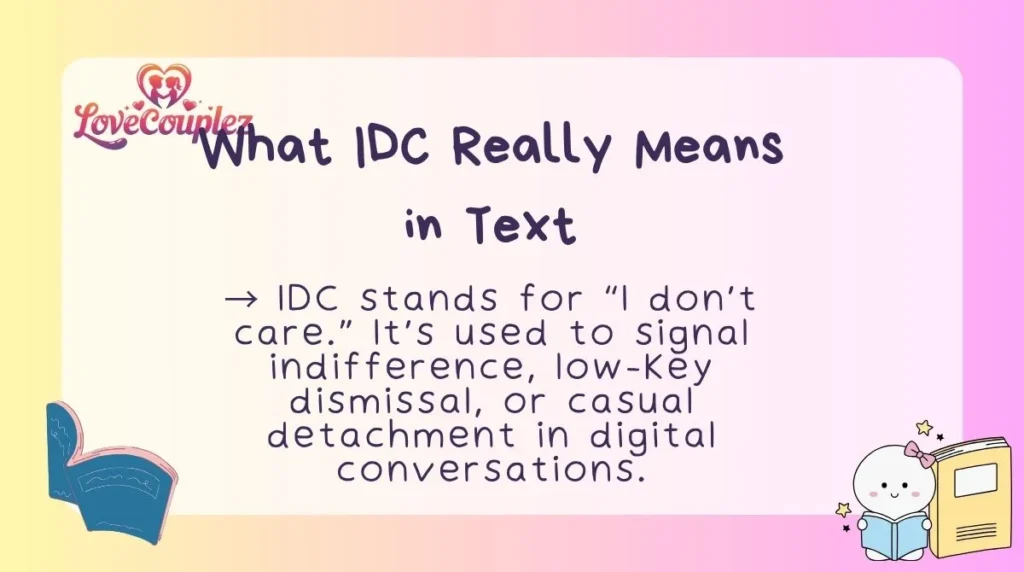
→ IDC stands for “I don’t care.” It’s used to signal indifference, low-key dismissal, or casual detachment in digital conversations. Often seen in fast chats, memes, or comment threads, it’s a quick way to show lack of concern without extra typing.
Quick Meaning Points:
• Tone: Neutral to slightly dismissive
• Who uses it most: Gen Z, teens, and young adults
• Where used most: TikTok, Discord, Instagram, gaming chats
• Example sentence: “You want pineapple on pizza? idc, eat what you want lol.”
Core Meaning Explained
At its core, idc is shorthand for “I don’t care.” Simple, right? But in digital culture, it carries nuance. Depending on context, it can:
- Show casual indifference (“idc, do whatever”).
- Signal playful detachment in banter (“idc, you’ll lose anyway”).
- Express mild annoyance or frustration without confrontation.
Unlike traditional speech, where tone of voice conveys meaning, online texts rely on brevity and context. That’s why idc meaning in text is so fluid—it’s not just what you say, but how, when, and where you say it.
Origin + Evolution Timeline
Early Internet Roots (1990s–2000s):
The phrase “I don’t care” was already common in chatrooms and instant messaging (AIM, MSN Messenger). Abbreviations like IDC emerged for speed and character limits.
Meme Spread Phase (2010–2018):
With Twitter, Tumblr, and early TikTok memes, IDC became a punchy text reaction. Memes often paired it with apathetic or sarcastic imagery, reinforcing a “whatever” tone.
Mainstream Adoption (2019–2025):
As Gen Z dominated social media, IDC evolved beyond text messages. It appeared in captions, TikTok trends, and Discord servers as a casual digital shrug.
2026 Current Usage:
Today, IDC is fully integrated into Gen Z digital culture. It’s not rude by default—it’s a shorthand emotional tool. Influencers, gamers, and meme creators use it for reactions, comic timing, or nonchalant responses.
How Gen Z Uses IDC Today
TikTok:
Used in video captions or comment replies to express a “meh” reaction to trends, challenges, or debates.
Discord:
Common in gaming servers or chatrooms to signal indifference to plans or opinions. Often paired with emojis for tone.
Gaming Chat:
Quick shorthand for “I don’t care” when arguing or coordinating with teammates.
Instagram Comments:
Reacting to opinions or content without committing emotionally.
Text Messages:
Classic peer-to-peer usage. Perfect for casual conversations or playful arguments.
Real Chat Style Examples
Friend 1: “Do you want to watch that scary movie tonight?”
Friend 2: “idc, your choice lol”
Friend 1: “Should I buy the new game or wait for a sale?”
Friend 2: “idc, just get it if you want”
Friend 1: “I think pineapple pizza is disgusting!”
Friend 2: “idc, it’s fire ngl 🍍”
Similar Slang Comparison Section
- IDC vs IDGAF: “IDGAF” is stronger, more aggressive “I don’t give a f***,” while IDC is casual.
- IDC vs Meh: “Meh” expresses mild indifference; IDC conveys choice-neutral detachment.
- IDC vs NVM: “NVM” is “never mind,” often retracting interest; IDC expresses ongoing indifference.
- IDC vs SMH: “SMH” is frustration/disbelief; IDC is disinterest without judgment.
Using these comparisons strategically improves SEO for slang meaning content targeting multiple search intents.
Psychological + Social Meaning
IDC is more than shorthand—it’s social signaling:
- Why people use it: Saves effort, communicates emotion efficiently, or sets boundaries.
- Social validation behavior: Using IDC can signal cool detachment or self-confidence.
- Online identity signaling: Indicates you’re casual, not overly reactive, part of Gen Z digital literacy.
It’s a subtle tool for establishing social tone while staying emotionally “light” online.
When NOT To Use This Slang
- Professional situations: Slack, emails, or client chats—IDC looks careless.
- Older audience: Some older adults may misinterpret it as rude or dismissive.
- Formal writing: Essays, reports, or serious discussions—stick to full phrases.
Is This Slang Still Trending in 2026?
Yes. IDC remains a Gen Z staple, thriving in meme culture, social video reactions, and online chats. Prediction: It will likely persist but may evolve with new shorthand like IDKY (I don’t know, yet) or emoji-driven expressions.
Pro Tips to Use Naturally
- Pair with emojis for tone: “idc 😏”
- Use in casual, fast-paced chats
- Combine with humor: “idc, eat the cake 🍰”
- Avoid in debates where clarity is needed
- Read the room—some groups prefer full words
Common Mistakes
- Using IDC in professional emails.
- Overusing it in a single conversation—can feel dismissive.
- Mixing with formal language (“idc about your quarterly report”).
- Misinterpreting context—sometimes IDC is playful, not hostile.
- Using it with older audiences who may take offense.
Related Slang Words (Mini Glossary)
- IDGAF: Stronger “I don’t care” expression
- Meh: Mild indifference
- NVM: “Never mind,” retracting attention
- SMH: “Shaking my head,” frustration
- BRB: “Be right back,” breaks in conversation
- TBH: “To be honest,” honest perspective
- FOMO: Fear of missing out
- YOLO: You only live once
- TMI: Too much information
- AF: “As f***,” intensifier
FAQ
What does IDC mean in texting 2026?
It’s shorthand for “I don’t care,” widely used in casual chats, memes, and social media reactions.
Is IDC rude?
Not inherently. Tone and context define whether it’s neutral, playful, or slightly dismissive.
Where is IDC used most online?
TikTok, Discord, gaming chats, Instagram comments, and text messaging.
How is IDC different from IDGAF?
IDC is casual indifference; IDGAF is stronger, more explicit detachment.
Can I use IDC professionally?
It’s best avoided in professional, older, or formal contexts—it can seem careless.
Conclusion
Understanding idc meaning in text is key to decoding Gen Z digital culture. It’s more than three letters—it’s social nuance, humor, and online identity.
Next time you see idc in a comment or chat, you’ll know exactly what tone and intention it carries.