Slang evolves faster than you can refresh TikTok. One day you’re confused by a word, the next day it’s in every meme, caption, and group chat.
Among Gen Z and digital natives, abbreviations and shorthand rule how we communicate online. “TM” is one of those terms that’s popped up everywhere—from Instagram comments to Discord threads—and it’s more than just a few letters.
Understanding TM meaning in text is key to decoding today’s digital conversations.
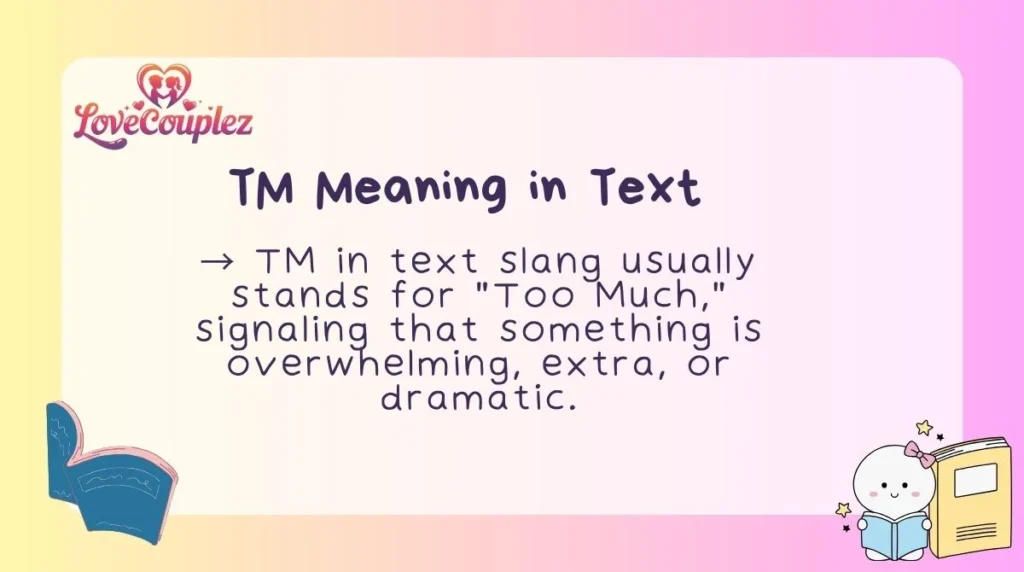
What does TM mean in slang?
→ TM in text slang usually stands for “Too Much,” signaling that something is overwhelming, extra, or dramatic.
Quick Meaning Points:
• Tone: Neutral to playful, sometimes slightly sarcastic
• Who uses it most: Gen Z and younger Millennials
• Where used most: TikTok captions, Discord chats, Instagram comments, text messages
• Example sentence: “That outfit is TM, I can’t even 😂”
Core Meaning Explained
TM is shorthand for “Too Much,” a phrase used to describe anything excessive, intense, or over the top. It’s flexible: it can praise something spectacular, tease a friend who’s overreacting, or point out absurdity in a meme. The tone depends on context. On TikTok, for instance, a creator might caption a chaotic video with “TM” to highlight the humor or chaos, while in a DM, a friend might say it when reacting to dramatic storytelling.
TM captures the emotional intensity of a moment in a few letters. Unlike longer phrases, it communicates a reaction instantly, perfect for scrolling culture where attention spans are short and digital engagement is fast.
Origin + Evolution Timeline
- Early internet roots (late 1990s–2000s): TM appeared as a literal “trademark” abbreviation in forums but occasionally got misread in text-based communities.
- Meme spread phase (2010–2018): Shortened internet phrases like LOL, SMH, and TM began circulating in early meme culture. “TM” started popping up in reaction posts and Tumblr text chains.
- Mainstream adoption (2019–2025): Social media apps like Instagram, Twitter, and TikTok helped TM evolve into the “Too Much” shorthand recognized today.
- 2026 current usage: TM is widely understood by Gen Z and younger audiences across TikTok, Discord, gaming chats, and texting. It conveys instant context for over-the-top content or emotional intensity.
How Gen Z Uses TM Today (2026 Focus)
TikTok: Captioning videos that are visually chaotic, exaggerated, or humorous. Example: “This dance is TM 😂”
Discord: Reacting in group chats when someone shares over-the-top stories or memes.
Gaming chat: Commenting on extreme plays, absurd moments, or lag-related frustrations. Example: “That boss fight was TM bro”
Instagram comments: Highlighting stylish, funny, or dramatic posts.
Text messages: Quick shorthand when replying to friends about anything intense or extra.
Real Chat Style Examples
Friend 1: Did you see Jenna’s cosplay?
Friend 2: OMG yes, TM! She looks outrageous😍
Friend 1: This new TikTok trend is wild
Friend 2: TM, can’t keep up lol
Friend 1: My group chat blew up last night
Friend 2: TM, I saw all those notifications!
Similar Slang Comparison
- OMG: Expresses surprise; TM expresses intensity or exaggeration.
- Extra: Very similar, implies over-the-top behavior.
- LOL: Shows laughter; TM can convey playful exaggeration.
- Big Mood: Captures relatable emotion; TM focuses on intensity or chaos.
- Yikes: Points to discomfort; TM can do similar but with humor.
Psychological + Social Meaning
People use TM for social signaling. Using shorthand like TM shows cultural awareness and digital literacy. It helps users:
- Express emotions concisely.
- Align with peer group humor.
- Signal understanding of meme culture.
- Build identity online through shared language.
It’s also a quick way to show social validation. Reacting with TM can affirm a friend’s dramatic story, amplify humor in a meme, or join the communal reaction without long commentary.
When NOT To Use This Slang
- Professional situations: Emails, reports, or meetings where clarity and formality matter.
- Older audience: Some may misinterpret TM as a literal trademark or not get the nuance.
- Formal writing: Articles, essays, or serious content shouldn’t use TM casually.
Is This Slang Still Trending in 2026?
TM remains relevant in 2026, particularly among Gen Z and meme culture enthusiasts. Its brevity suits fast digital consumption, and its versatility keeps it embedded in captions, chats, and gaming conversations. Predictably, TM will evolve further, potentially branching into new hybrid expressions or integrating with emerging AR/VR social platforms.
Pro Tips to Use Naturally
- Use TM for genuine reactions to drama or chaos.
- Pair with emojis for tone clarity.
- Observe context; humor vs. serious moments.
- Don’t overuse; it’s impactful when sparingly applied.
- Combine with other slang to match platform culture.
Common Mistakes
- Using TM in formal writing.
- Misinterpreting TM as trademark.
- Overusing TM, which reduces effect.
- Using TM with audiences unfamiliar with modern slang.
- Confusing TM with similar acronyms (TMI, TYT).
Related Slang Words (Mini Glossary)
- TMI: Too Much Information
- LOL: Laugh Out Loud
- SMH: Shaking My Head
- Extra: Over the top
- Big Mood: Relatable emotion
- Yikes: Express discomfort or shock
- Sus: Suspicious or questionable
- Flex: Show off or boast
- Cap/No Cap: Lie / no lie
- Slaps: Really good, especially music
FAQ
What does TM mean on TikTok?
TM stands for “Too Much” and highlights dramatic, exaggerated, or intense content.
Is TM a positive or negative slang?
Depends on context; can be playful, teasing, or complimentary.
Who uses TM the most?
Primarily Gen Z, but younger Millennials also use it online.
Can I use TM in professional texts?
Not recommended; it’s informal and best for casual digital conversations.
How is TM different from Extra?
Extra often describes behavior; TM describes intensity, chaos, or over-the-top moments.
Conclusion
TM is more than just letters—it’s a snapshot of 2026 digital culture. Mastering its use lets you communicate with clarity, humor, and social finesse online.
Share TM in your next chat and see the reactions light up.