Internet language changes faster than fashion trends. A word that didn’t exist in everyday conversations a few years ago suddenly appears everywhere—from gaming chats to TikTok comments and late-night text messages between friends.
One short slang expression that keeps popping up in digital conversations is “yk.” You might see it at the end of a sentence, in a casual DM, or inside a meme caption.
People use it because typing quickly matters in online culture. Gen Z especially prefers short, expressive phrases that communicate emotion without long explanations.
But yk meaning in text is more than just a shortcut. It reflects how modern communication works: fast, casual, and built on shared understanding.
Understanding this slang helps decode how people talk online in 2026.
What does yk meaning in text mean in slang?
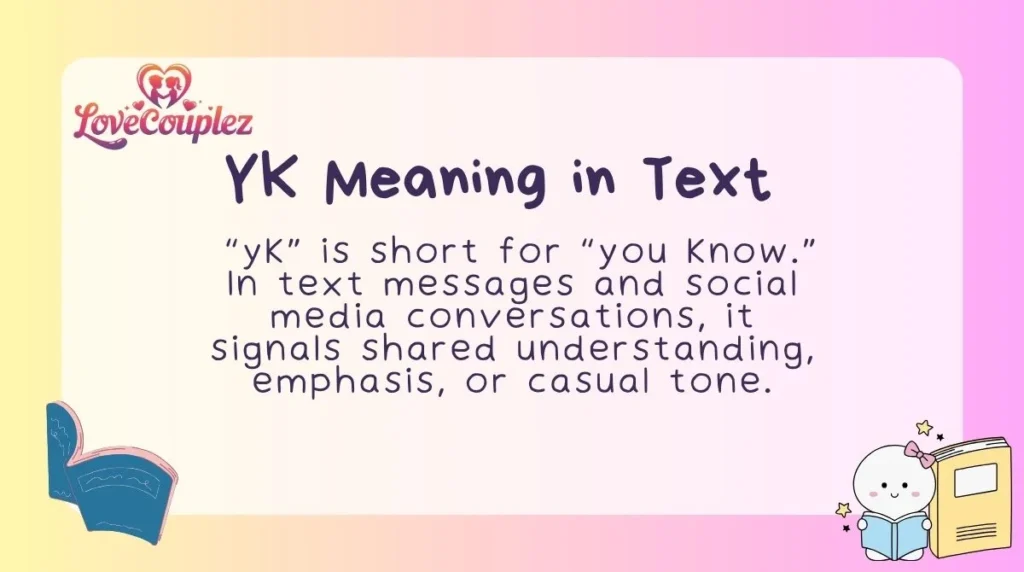
→ “yk” is short for “you know.” In text messages and social media conversations, it signals shared understanding, emphasis, or casual tone. People use it to soften statements, add relatability, or suggest that the other person already understands the context of what’s being said.
Quick Meaning Points:
• Tone (Positive / Negative / Neutral): Mostly neutral and friendly
• Who uses it most: Gen Z and young millennials
• Where used most: TikTok comments, Discord chats, gaming messages, Instagram DMs
• Example sentence: “That late night drive vibe hits different, yk?”
Core Meaning Explained
At its core, yk simply stands for “you know.”
However, in modern digital communication, it carries more emotional nuance than the literal phrase.
People use yk for several subtle reasons:
Shared understanding
The speaker assumes the listener understands what they mean.
Example:
“Winter nights feel peaceful, yk.”
Softening a statement
It makes a message sound less direct or less serious.
Example:
“I might skip the party tonight, yk… feeling tired.”
Adding relatability
It invites the other person to mentally agree.
Example:
“That first sip of coffee in the morning, yk?”
In slang communication, words like yk function as social glue. They help maintain connection and familiarity in short digital conversations.
Because texting lacks tone of voice and body language, people use small slang signals like this to create warmth and shared context.
Origin and Evolution Timeline
Internet slang rarely appears overnight. Most expressions grow slowly through different online communities before becoming mainstream.
Early internet roots
Short forms like “u,” “r,” “idk,” and “brb” became common during the early days of online chatting in the late 1990s and early 2000s.
Typing speed mattered on platforms like:
• MSN Messenger
• AOL chat rooms
• early SMS texting
During this time, “yk” began appearing as a quick way to write “you know.”
Meme spread phase
In the 2010s, platforms like Twitter and Tumblr accelerated slang evolution.
Users started shortening phrases not just for speed but for style. Minimalist typing became part of online personality.
“yk” started appearing in tweets such as:
“Life feels weird sometimes, yk?”
Memes and relatable posts helped spread the phrase.
Mainstream adoption
Around the early 2020s, texting culture shifted heavily toward casual shorthand communication.
Apps like:
• TikTok
• Snapchat
• Discord
• Instagram messaging
encouraged quick, relaxed conversation.
As Gen Z dominated these spaces, yk meaning in text became extremely common.
2026 current usage
By 2026, yk has become part of everyday online conversation.
It appears in:
• TikTok captions
• gaming chat messages
• casual text conversations
• Instagram comment threads
Most users don’t even think about it anymore—it simply feels natural.
How Gen Z Uses YK Today
Digital slang evolves based on platform culture. Each social media space uses yk slightly differently.
TikTok
TikTok captions often include relatable phrases.
Example:
“Late night overthinking hits hard, yk.”
The phrase makes the caption feel conversational and emotionally relatable.
Discord
In Discord servers, users type quickly during conversations.
Example:
“Server lagging again, yk how it is.”
Here it acts like a conversational filler.
Gaming chat
Gamers often use quick shorthand during gameplay discussions.
Example:
“Just warming up today, yk.”
The tone is casual and friendly.
Instagram comments
Instagram comments often aim for relatability.
Example:
“Sunset photos always hit different, yk.”
This invites agreement from readers.
Text messages
In private conversations, yk often softens statements.
Example:
“I just needed some quiet time today, yk.”
It creates a relaxed tone.
Real Chat Style Examples
Below are realistic message exchanges showing how people naturally use yk.
Friend 1:
“Bro that movie ending was unbelievable”
Friend 2:
“Yeah I expected it but still surprised, yk?”
Friend 1:
“I kinda want to travel somewhere random this year”
Friend 2:
“Same honestly… just disappear for a week, yk?”
Friend 1:
“Why do late night talks feel deeper”
Friend 2:
“Because everyone’s honest at night, yk?”
Friend 1:
“I might delete social media for a while”
Friend 2:
“Lowkey not a bad idea, yk.”
These examples show how yk works as a natural conversational filler rather than a strict statement.
Similar Slang Comparison
Many internet slang expressions serve similar conversational purposes.
Understanding the differences helps avoid confusion.
YK
Meaning: “You know”
Usage: Signals shared understanding or relatability.
Example:
“That vibe was weird, yk.”
FR
Meaning: “For real”
Usage: Emphasizes agreement.
Example:
“That game was hard, fr.”
TBH
Meaning: “To be honest”
Usage: Introduces a genuine opinion.
Example:
“TBH I liked the first season more.”
IMO
Meaning: “In my opinion”
Usage: Clarifies personal viewpoint.
Example:
“IMO that restaurant is overrated.”
IDK
Meaning: “I don’t know”
Usage: Expresses uncertainty.
Example:
“IDK what movie we should watch.”
Compared to these, yk functions more like a tone modifier than a direct statement.
Psychological and Social Meaning
Internet slang is not just about saving time. It also reflects deeper social behaviors.
Shared identity
Using slang signals belonging to a digital generation.
When people write yk, they show familiarity with modern online culture.
Social validation
The phrase subtly asks the reader to agree.
Example:
“That song feels nostalgic, yk.”
Readers naturally respond mentally with agreement.
Emotional softening
Digital communication can feel blunt without vocal tone.
Small phrases like yk soften statements and make them feel friendlier.
Conversational rhythm
Online conversation mimics spoken language.
In real speech, people say:
“You know what I mean.”
Text slang replicates that rhythm in written form.
When Not To Use This Slang
Although slang works well in casual communication, some contexts require formal language.
Professional environments
Avoid using yk in:
• work emails
• job applications
• business communication
Example to avoid:
“I finished the report early, yk.”
Academic writing
Formal essays or research papers should avoid slang expressions.
Talking with older audiences
Some older readers may not understand modern internet abbreviations.
Public announcements
Clear communication works better than slang in official messages.
In general, yk meaning in text belongs mainly to informal digital conversation.
Is This Slang Still Trending in 2026?
Yes, but with an interesting twist.
Unlike viral slang that fades quickly, yk is becoming a stable part of internet language.
Reasons it remains popular:
• extremely simple
• easy to type
• widely understood
• fits casual communication
Trend analysts believe it will likely remain common for several years because it behaves like a natural speech filler.
Rather than a trend, it’s evolving into a permanent digital shorthand.
Pro Tips to Use Naturally
Using slang correctly helps conversations feel authentic.
Helpful tips:
• Use yk at the end of casual statements
• Avoid overusing it in every sentence
• Use it mainly with friends or informal chats
• Let it follow relatable thoughts or emotions
• Keep messages natural and conversational
Example:
Natural:
“That song gives summer vibes, yk.”
Forced:
“yk I think yk the weather is nice yk.”
Balance is key.
Common Mistakes
Even simple slang can be misused.
Here are frequent mistakes people make with yk meaning in text.
Using it in formal writing
Professional communication should avoid slang abbreviations.
Overusing it repeatedly
Typing yk in every sentence feels unnatural.
Using it with strangers
Some people may not understand the shorthand.
Misinterpreting tone
Sometimes readers may think the message sounds sarcastic.
Writing it in capital letters
Most people type it casually as yk, not YK.
Related Slang Words
Modern internet culture contains many similar shorthand expressions.
Here are commonly used ones.
IK
Short for “I know.”
IDC
Means “I don’t care.”
SMH
Expresses disappointment or disbelief.
LMK
Means “let me know.”
BTW
Short for “by the way.”
NGL
Means “not gonna lie.”
IMO
Means “in my opinion.”
FOMO
Fear of missing out.
Learning these expressions helps understand digital conversations more easily.
FAQ
What does yk mean in texting?
In texting, yk is a shorthand version of “you know.” It signals shared understanding or relatability in casual conversation.
What does yk mean on TikTok?
On TikTok, yk often appears in captions or comments to make statements feel relatable, conversational, or emotionally expressive.
Example:
“That late night scrolling feeling, yk.”
Is yk rude or disrespectful?
No. The slang is generally neutral and friendly. It simply reflects informal communication style.
Why do people say yk instead of you know?
People shorten phrases to type faster and keep conversations casual. Internet slang favors speed and simplicity.
Is yk Gen Z slang?
Yes. While it existed earlier, Gen Z popularized it through texting, memes, gaming chats, and social media conversations.
Conclusion
Modern digital language constantly evolves, and small expressions often reveal big cultural shifts. YK meaning in text may look like a simple abbreviation, but it represents how online communication prioritizes speed, relatability, and shared understanding.
By using tiny conversational signals like yk, people recreate natural speech patterns in written messages. That’s why the phrase appears everywhere—from TikTok captions to late-night group chats.
Understanding slang like this helps decode modern internet culture and keeps conversations flowing naturally in the fast-moving world of social media.