Online language changes faster than fashion. One year everyone types full sentences, the next year a single letter carries the entire conversation. That is exactly what happened with k meaning in text.
If you spend time on social media, gaming chats, or texting friends, you have probably seen it. Someone writes a long message and the reply comes back as just “k.”
Instant confusion.
Is the person annoyed? Are they busy? Are they being sarcastic? Or is it simply a fast way to say okay?
Gen Z communication thrives on speed, emotion, and subtle signals. Small differences in punctuation, emojis, or letter choice can change the tone completely. Understanding how k meaning in text works helps you avoid awkward conversations and read digital vibes more accurately in 2026.
What does k meaning in text mean in slang?
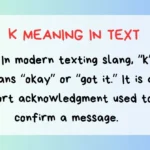
→ In modern texting slang, “k” means “okay” or “got it.” It is a short acknowledgment used to confirm a message. Depending on context and tone, it can feel neutral, casual, dismissive, or slightly annoyed when used without emojis or additional words.
Quick Meaning Points:
• Tone: Neutral, sometimes cold or passive-aggressive
• Who uses it most: Gen Z, gamers, fast texters
• Where used most: Text messages, gaming chat, TikTok comments, Discord
• Example sentence: “Meet at 7?” — “k”
Core Meaning Explained
At its core, k meaning in text is extremely simple.
It is just a shortened version of “okay.”
But internet communication is never only about literal meaning. Tone, timing, and context give the message its emotional weight.
When someone sends “k”, they usually mean one of these things:
Quick acknowledgment
They saw the message and confirmed it.
Minimal response
They do not want to continue the conversation.
Busy moment
They reply quickly because they are doing something else.
Emotional distance
Sometimes it subtly signals irritation or boredom.
The interesting part is that the same single letter can feel polite or rude depending on context.
Compare these examples:
Friend: “I’ll call you later.”
Reply: “k”
This feels neutral.
But in another scenario:
Friend: “Did you forget my birthday?”
Reply: “k”
Now it feels cold or dismissive.
That emotional ambiguity is why k meaning in text became such a popular discussion topic online.
Origin and Evolution of “K” in Internet Language
Early internet roots
The shortened “k” appeared during early internet messaging in the late 1990s and early 2000s.
People using:
- SMS texting with character limits
- Instant messengers like MSN
- Early chatrooms
wanted to reply quickly without typing full words.
“OK” already existed as a fast response, but “k” became even faster.
One keypress.
Meme spread phase
During the 2010s, memes started joking about the emotional power of “k.”
Screenshots of awkward conversations went viral because the reply “k” looked unintentionally rude.
Memes often showed situations like:
Long emotional message → reply: “k.”
This turned the letter into a symbol of passive-aggressive texting.
Mainstream adoption
By the late 2010s and early 2020s:
- texting apps became faster
- Gen Z preferred short responses
- reaction culture exploded
“K” became widely used across platforms.
It appeared everywhere:
- group chats
- gaming voice text chats
- comment replies
Current usage in 2026
In 2026 digital culture, k meaning in text sits in a strange middle ground.
It is still common, but people are more aware of its emotional tone.
Many users now choose alternatives like:
- “ok”
- “kk”
- “okay”
- “👍”
to avoid sounding annoyed.
Still, “k” remains one of the most recognizable micro-responses in internet slang.
How Gen Z Uses K Today (2026 Digital Culture)
Gen Z communication relies heavily on speed, context, and micro-signals. The meaning of “k” changes slightly depending on the platform.
TikTok comments
On short-form video platforms, “k” is rarely used as a conversation reply.
Instead it often appears in sarcastic or dismissive comments.
Example:
User: “This trend is amazing.”
Reply: “k.”
Here it implies:
“I disagree but don’t want to argue.”
Discord chats
Gaming and community servers prioritize fast communication.
“K” is common here because conversations move quickly.
Example:
“Raid starts at 8.”
Reply:
“k”
No emotion implied. Just confirmation.
Gaming chat
Competitive games require fast typing.
Players often respond with single letters like:
- k
- g
- gg
- ok
In this environment, k meaning in text is purely functional.
Instagram comments
In comment sections, “k” often signals dismissive humor.
Example:
User 1: “This outfit is iconic.”
User 2: “k.”
The short reply acts like a sarcastic shrug.
Text messages
This is where misunderstandings happen most.
Because texting is personal, “k” can feel emotionally distant.
Compare:
“Okay 🙂” → friendly
“ok” → neutral
“k” → possibly annoyed
Tiny differences change how people interpret the message.
Real Chat Style Examples
Seeing real conversation patterns helps understand k meaning in text better.
Example conversation
Friend 1:
“You bringing snacks tonight?”
Friend 2:
“k”
Meaning: confirmation.
Friend 1:
“I’m sorry I forgot to call.”
Friend 2:
“k”
Meaning: possibly upset.
Friend 1:
“Game starting now.”
Friend 2:
“k joinin”
Meaning: fast response during gaming.
Friend 1:
“You still mad?”
Friend 2:
“k whatever”
Meaning: sarcastic tone.
Friend 1:
“Send me the file later.”
Friend 2:
“k 👍”
Meaning: friendly acknowledgment.
Similar Slang Comparison
Understanding similar slang helps clarify k meaning in text.
OK
The original word.
Tone: neutral and safe.
Used widely in professional and casual chats.
Ok
Slightly more relaxed than “OK.”
Still friendly and common in texting.
Kk
A more positive version of “k.”
Doubling the letter makes it sound less cold and more playful.
Example:
“Meet at 6?”
“kk”
Bet
A popular Gen Z slang meaning agreement or confirmation.
Example:
“Movie tonight?”
“Bet.”
Aight
Casual slang for “alright.”
Often used in voice-style texting.
Example:
“Aight see you later.”
These alternatives exist partly because people worry that “k” feels too blunt.
Psychological and Social Meaning
Why does such a tiny message matter so much?
Because digital communication removes tone of voice and facial expression.
When someone receives a one-letter reply, the brain automatically tries to interpret the emotional intent.
Minimal effort signals
Short replies can signal:
- disinterest
- distraction
- emotional distance
People interpret effort as a sign of care in conversation.
Social validation behavior
Online communication often acts as micro-validation loops.
People expect responses like:
- emojis
- reactions
- full words
When they receive only “k,” it can feel like their message was dismissed.
Online identity signaling
Gen Z often uses communication style as part of identity.
Examples include:
- lowercase typing
- no punctuation
- short replies
Using “k” sometimes signals a relaxed, minimalist texting style.
But depending on context, it can also feel intentionally cold.
When Not To Use This Slang
Although common, k meaning in text is not appropriate in every situation.
Professional communication
Never use it in work messages.
Example:
Manager: “Please send the report by 3 PM.”
Replying with “k” can appear disrespectful.
Use:
“Okay, I’ll send it.”
Older audiences
Many older users interpret “k” as rude or dismissive.
Using full words avoids confusion.
Formal writing
Emails, academic messages, and professional platforms require clear language.
“K” looks careless in formal contexts.
Emotional conversations
During serious discussions, minimal replies can escalate misunderstandings.
Typing a full response shows empathy.
Is This Slang Still Trending in 2026?
The short answer: yes, but with nuance.
“K” remains widely understood, but its popularity is evolving.
Current trends show three patterns.
Emoji responses increasing
People often replace “k” with reactions like:
👍
🙂
✔️
These provide confirmation without sounding cold.
Voice messages growing
Messaging apps now encourage voice replies, reducing ultra-short text responses.
Irony culture
Gen Z sometimes uses “k” intentionally for dry humor or sarcasm.
Example meme format:
Long dramatic rant → reply: k
Because of this irony culture, the slang is unlikely to disappear anytime soon.
It has become part of the internet’s emotional shorthand language.
Pro Tips to Use K Naturally
Using k meaning in text correctly depends on context.
Helpful guidelines include:
• Use it when confirming simple information
• Avoid using it after emotional messages
• Add emojis if you want to soften the tone
• Use it in fast chats like gaming or group messages
• Prefer “ok” or “okay” in personal conversations
These small adjustments prevent misunderstandings.
Common Mistakes
Even experienced texters misuse this slang sometimes.
Assuming it always means anger
“K” often simply means “got it.”
Do not overanalyze every message.
Using it in serious conversations
It can feel dismissive when someone shares something important.
Using it with authority figures
Teachers, managers, or clients may interpret it as disrespectful.
Misreading gaming chat tone
In gaming communities, “k” is purely functional.
Ignoring context
The meaning depends heavily on the surrounding conversation.
Always read the full chat before judging the tone.
Related Slang Words (Mini Glossary)
Understanding nearby slang improves your knowledge of digital language.
Bet
Agreement or approval.
FR
Short for “for real.”
No cap
Means someone is telling the truth.
IDK
“I don’t know.”
TBH
“To be honest.”
SMH
“Shaking my head,” showing disbelief.
W
Short for “win,” meaning something good.
L
Short for “loss,” meaning something embarrassing.
These expressions form part of the fast-paced vocabulary used across social media and messaging apps.
Frequently Asked Questions
Is “k” rude in texting?
It can feel rude depending on context. If used after a long emotional message, it may appear dismissive. In quick logistical conversations, it usually just means “okay.”
What does “k” mean from a girl or guy?
The meaning does not change based on gender. It simply means “okay,” though tone depends on context, relationship, and conversation style.
What does “k” mean on TikTok comments?
On TikTok, “k” is often used sarcastically or dismissively in replies to opinions.
Is “k” different from “ok”?
Yes. “Ok” feels more neutral and friendly, while “k” is shorter and sometimes perceived as colder.
Why do people reply with just “k”?
Most people use it because it is fast and efficient. In some cases it also signals that the conversation does not need to continue.
conclusion
Digital culture constantly compresses language into smaller and faster forms. From emojis to abbreviations, people communicate entire emotions with minimal effort.
Understanding k meaning in text reveals how subtle online signals shape conversation tone. The same letter can act as a polite acknowledgment, a neutral confirmation, or a sarcastic response depending on context.
Knowing when and how to use it helps you navigate modern messaging without accidentally sounding rude.
If you pay attention to timing, tone, and platform culture, even a one-letter message can communicate exactly what you intend.