Slang moves faster than trends, faster than apps, faster than attention spans. One day a phrase is everywhere, the next it’s gone—or worse, misunderstood.
In 2026, digital communication is compressed, coded, and emotionally loaded. People don’t just type words anymore, they signal mood, boundaries, and identity in seconds.
That’s exactly where “dnd meaning in text” becomes important.
You’ve probably seen “DND” pop up in messages, TikTok comments, Discord chats, or even gaming lobbies. Sometimes it feels obvious. Other times, confusing. Is it rude? Is it serious? Or just casual slang?
Let’s break it down in the way real people actually use it today.
What does dnd meaning in text mean in slang?
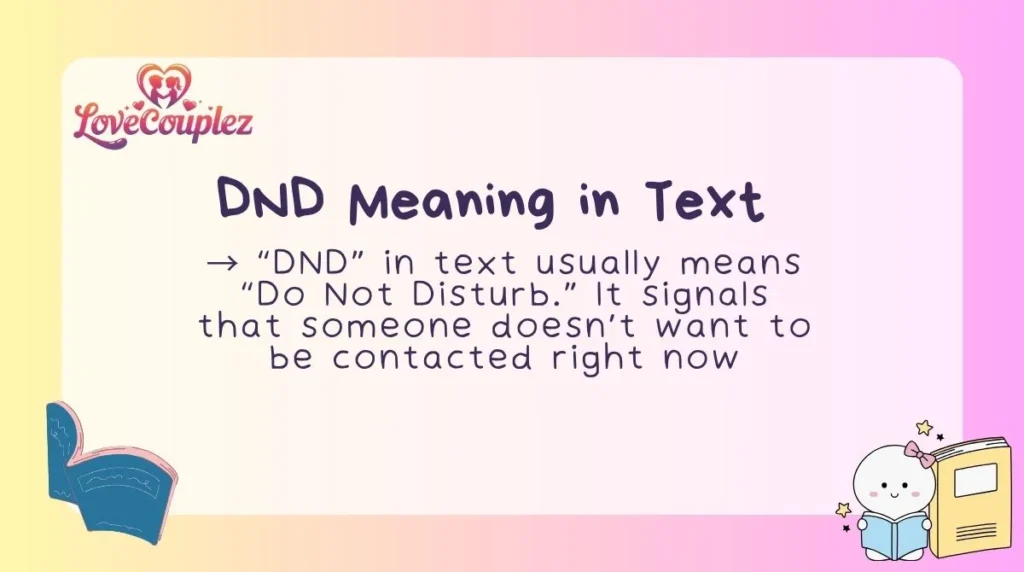
→ “DND” in text usually means “Do Not Disturb.” It signals that someone doesn’t want to be contacted right now. It can be serious (busy, sleeping) or casual (just ignoring messages temporarily). Context decides the tone, especially in social and gaming conversations.
Quick Meaning Points:
• Tone: Neutral to slightly negative
• Who uses it most: Gen Z, gamers, online communities
• Where used most: TikTok, Discord, texting, gaming chats
• Example sentence: “I’m on DND, reply later.”
Core Meaning Explained
At its core, DND = Do Not Disturb.
Simple. But in modern slang usage, it’s more than just a literal instruction.
It acts as a digital boundary marker.
When someone types “DND” in a message, bio, or status, they are saying:
- “I don’t want interruptions”
- “I’m focusing on something”
- “I’m not emotionally available right now”
- Or even: “I’m ignoring messages on purpose”
That last one is where meaning shifts.
Because tone depends heavily on context:
- In gaming → totally normal
- In texting → can feel distant
- In relationships → can feel cold
So while the slang definition is simple, the emotional weight behind it isn’t.
Origin + Evolution Timeline
Early Internet Roots
“Do Not Disturb” existed long before slang culture. It started as a feature in phones, messaging apps, and operating systems.
It was purely functional.
No emotion. No hidden meaning.
Meme Spread Phase
As online culture evolved, users started shortening everything.
DND became:
- Status updates on messaging apps
- Gamer tags during matches
- Quick replies in chat
It shifted from a setting to a statement.
Mainstream Adoption
With platforms like TikTok and Discord growing, DND entered everyday communication.
People began using it casually:
- “DND rn” (right now)
- “I’m DND mode”
- “Put myself on DND”
Now it wasn’t just about notifications—it was about mindset.
2026 Current Usage
In 2026, DND is fully integrated into digital behavior.
It represents:
- Focus culture
- Emotional boundaries
- Social burnout
- Selective communication
It’s not just what you do—it’s how you present yourself online.
How Gen Z Uses DND Today (2026 Focus)
TikTok
DND shows up in captions and comments:
- “On DND, don’t text me 😂”
- “DND mode after this”
It’s often paired with humor or burnout content.
Discord
Very common and literal:
- Users set status to DND
- Means: don’t ping or expect replies
But socially, it also signals: “I’m here, but not engaging.”
Gaming Chat
In games, DND is respected.
- Indicates focus or competitive mode
- Means: no distractions
Here, it’s purely functional and accepted.
Instagram Comments
Used more casually:
- “He put me on DND fr 😭”
- “I’m going DND after this”
Often used for emotional storytelling or jokes.
Text Messages
This is where things get tricky.
“DND” in texts can feel:
- Neutral → “I’ll reply later”
- Cold → “Don’t message me”
- Avoidant → “I don’t want to talk”
Same word, different emotional impact.
Real Chat Style Examples
Friend 1:
Bro where are you??
Friend 2:
On DND, studying. Chill.
Friend 1:
You didn’t reply all day 😑
Friend 2:
Yeah sorry, DND mode
Friend 1:
Game tonight?
Friend 2:
Already DND, grinding ranked
Friend 1:
Why you ignoring me
Friend 2:
Not ignoring, just DND rn
Similar Slang Comparison Section
Understanding similar slang helps you use DND more naturally.
AFK (Away From Keyboard)
More temporary and physical absence
DND = intentional silence, not necessarily absence
Ghosting
Completely cutting off communication
DND = temporary boundary, not permanent
Busy
General and polite
DND = more direct and digital-native
Offline
Means not connected
DND = still online but not engaging
Muted
Ignoring notifications
DND = stronger, more visible signal
Psychological + Social Meaning
DND isn’t just a phrase—it’s behavior.
Why people use this slang
Because constant communication is exhausting.
DND gives people a quick way to:
- Protect their time
- Avoid awkward conversations
- Reduce social pressure
Social validation behavior
Posting “DND” can also be performative.
It signals:
- “I’m busy”
- “I have priorities”
- “I’m not always available”
This builds an image of control and independence.
Online identity signaling
In 2026, identity is curated.
Using DND communicates:
- Focus mindset
- Emotional boundaries
- Digital awareness
It tells others how to treat your time.
When NOT To Use This Slang
Even though it’s popular, DND isn’t always appropriate.
Professional situations
Avoid using DND in work emails or formal chats.
Instead say:
- “I’m currently unavailable”
- “I’ll respond later”
Older audience
Not everyone understands slang.
Using DND with older people can cause confusion or seem rude.
Formal writing
DND is casual slang.
Never use it in:
- Essays
- Reports
- Official communication
Is This Slang Still Trending in 2026?
Yes—and it’s evolving.
DND is no longer just trending, it’s normalized.
It’s part of:
- Digital wellness culture
- Focus routines
- Social boundary setting
Future prediction
DND will likely stay, but evolve into:
- More expressive versions
- Emojis + status combos
- Personalized status phrases
The concept won’t disappear—it will expand.
Pro Tips to Use Naturally
• Use DND when you genuinely need space
• Add context if needed (“DND, studying”)
• Don’t overuse—it can feel dismissive
• Match tone with relationship (friends vs close ones)
• Use casually in chats, not formally
Common Mistakes Section
Using it in serious conversations
Can seem cold or disrespectful
Overusing it daily
Makes people feel ignored
Not explaining context
Leads to misunderstandings
Using with new people
They might not get it
Confusing it with ghosting
DND is temporary, ghosting is not
Related Slang Words (Mini Glossary)
BRB – Be right back
IMO – In my opinion
IDK – I don’t know
TBH – To be honest
IRL – In real life
LMK – Let me know
FOMO – Fear of missing out
Lowkey – Slightly or secretly
Highkey – Obviously or strongly
No cap – No lie
FAQ
What does DND mean in text messages?
It means “Do Not Disturb,” signaling the person doesn’t want to be contacted right now.
Is DND rude in texting?
It depends on tone and context. With friends, it’s normal. In sensitive situations, it can feel cold.
What is DND meaning on TikTok?
On TikTok, it often means taking a break, ignoring messages, or joking about being unavailable.
Does DND mean ignoring someone?
Not always. It usually means temporary unavailability, not permanent avoidance.
Can I use DND in professional chats?
No. It’s better to use clear, polite phrases instead of slang.
Conclusion
DND started as a simple phone setting, but in 2026, it’s a full social signal. It tells people how you value your time, your energy, and your attention. Used right, it creates boundaries. Used wrong, it creates distance.
Mastering slang like this isn’t just about knowing meaning—it’s about understanding people.
If you found this helpful, share it with someone who still gets confused by modern texting slang.